January 11, 2017

Minaria: Time and Movement

The Divine Right rule book says that each hex is 50 miles across (Movement Phase: Zones of Control), so I'll just stick with that.  For overland movement rules I tend to prefer simplicity over accuracy.  I like accuracy.  It's a great goal.  It's just that I have a very limited amount of game time, so I strive to keep operations simple and easy to remember and then speed through them whenever possible.  People don't usually show up for game night just to watch me roll dice and do math.  

Anyhow, this is what I'm currently using to determine travel times.


Days per Hex

Terrain
Trackless
Road
Trail
Raft
Rowboat
Sailing Ship
Galley
Row+Sail
Dwarven Airship
Clear/Plains
2
2
-
-
-
1

Swamp
4
2
2
-
-
1

Forest
4
2
-
-
-
1

Hills
4
2
-
-
-
1

Mountain Pass
4
2
-
-
-
1

Mountains
8
4
-
-
-
1
Open Water
-
-
3
2
1
1
Cross a River
+1
Bridge
Pretty fast
-
-
Pretty fast
Upstream
-
-
5 (if pulled)
-
-
-
Downstream
-
-
1
-
-
-

Double these times if the party is encumbered.
Halve these times if the party is riding fast horses.
War Horses in armor move at normal human speed.
Dwarven Airships move fast in clear open skies, but are easily pushed off course by high winds.


January 10, 2017

My Minaria Sandbox

I've been running weekly game sessions every Thursday for over a year now. The PCs have mostly just been delving into Stonehell Dungeon and staying in the nearby town of Hardingham. We're still having a blast in Stonehell, but I want to spend some time detailing the surrounding world in case the group decides to roam around more.

I'll use the map from the board game Divine Right. It is awesome. Behold!


I've placed Stonehell and Hardingham in the Forest of the Lurking, a few hexes east of the Invisible School of Thaumaturgy. My goal is to fill every named site on that map using old D&D modules, some more recent purchases, and free adventures I find online. Expect more posts soon.

In addition to the map, I'm going to borrow some (but not all) of the lore and personalities from the game. I'll also combine in the historical elements that were already established in previous sessions. These come from many other sources: Stonehell, my old Ancients and Aliens campaign setting, Jeff Rients' World of Cinder, and a bunch of other random tidbits.


Here we go.


This is a brief rundown of the common knowledge regarding the history and nations of Minaria.  While not all of the information is precisely true, the information here is widely accepted by common folk throughout Minaria. Your characters already know all this stuff.

Early History

The Frog Gods, and the birth of the world
The earliest histories of Minaria are highly disputed, especially between the demi-human races.  Little is agreed upon except that the world was created, populated with beasts, and that it was a time of brutality and blood.  Chaotics claim that this was the golden age, when the croaking of the Frog Gods rang out across a world that was young and free; unsullied by the touch of insecure pretender gods who whine for order and control.  The chaotic priests’ calls to “Return Minaria to greatness!” appeal to some, but fill others with an anxious dread.  

The Ancients
Then came the Ancients.  Ascendant divinities or usurpers depending on who is asked.  These beings descended upon Minaria and took control almost immediately.  At this time, their magic and power were absolute.  They altered the land, the peoples, and even themselves into whatever designs they wished.  Though few in number the ancients were highly feared and revered.  It is agreed by all that the ancients created humanity, in addition to many other races; both hominid and monster.  Even the dragons were their slaves.  The Ancients ruled over all of Minaria for over a thousand years.  Those who refused to obey them were driven into hiding.  The pureblood elves, dwarves, and halflings claim to have hidden in the deepest tunnels of the world, while the ancients twisted their captured kin into mutant half-breed slave races.  Many of these races are now extinct (or nearly so), but the humans at least have proven to be exceptionally adaptable and prolific.

What happened next is unclear.  It’s as if the Ancients quietly packed up and left one day.  The few surviving glyphs and runes say that “...the Ancient ones stepped off the world of mortal men and went up into the heavens”.  Some claim that the Ancients ascended into divinity, and a few of these Old Gods are still worshiped to this day.  Others say that the ancients were never gods at all, but simply left the world once they grew tired of it, or perhaps their seers saw that the world might turn against them and so chose to leave before their control began slipping away.  

Little remains now of the ancient civilization other than eroded monuments and plundered ruins.  Many of the religions dedicated to the Old Gods claim to hold the true secrets of the Ancients, but the only group that is still uncovering new artifacts and ancient pre-draconic script are the so called Eaters of Wisdom who live at their sanctuary in the north called The Temple of Kings.

The Age of Dragons
After the Ancients came the Age of Dragons.  An indeterminate time when dragons were worshipped as living gods.  The dragons gathered large numbers of humanoid followers to care for their needs and to indulge their whims.  It is supposed that there was once a great civilization of the dragons, but little is known of this time due to the extensive efforts to remove it from history.  Some few dragons have survived to this day, and though they still surround themselves with human cults these followers have been bred for loyalty and fanaticism.  The dragon cults of today are forbidden the use of magic, and not even allowed to learn how to read and write.  Whatever knowledge the dragons still possess, they are keeping it to themselves.

The Cataclysm
Tempests, earthquakes, tidal waves, volcanic eruptions, and giant meteorite storms shattered the land and seemingly wiped out the dragon civilization.  Death and destruction were everywhere.  Many of the enslaved hominids came to believe that the cataclysm was divine retribution for the wickedness and arrogance of the dragons who claimed to be gods.  Soon the dragons found that they were being hunted by their former slaves under the banner of the new Church of the Gold Dragon which claims that all of the dragons in the mortal realm are fallen angels who were cast out of heaven after they rebelled against the great Gold Dragon.

The Empire of the Silver Potentate
The Silver Potentate rose to fame as a legendary dragon hunter.  He gathered an army of supporters, claimed to be a messiah and eventually took control of the Church of the Gold Dragon.  He and his armies drove the dragons far out into the wilderness, and he and the church destroyed any trace of the demonic draconic that they could find lest humanity be tricked and tempted once again to follow their evil ways.  Over time he came to rule an empire that spanned the continent of Minaria.  This was the golden age of humanity.  The Silver Potentate’s rule was good and just for many decades, but over the long march of years it turned dark and oppressive.  Some blame his madness on the constant use of magical potions of Longevity, others say that it was the dragon wounds which eventually festered within his heart.  Whatever the cause, the Silver Potentate’s increasing paranoia and delusions led to widespread oppression and persecution.  He created the vast prison known as Stone Hell to house suspected revolutionaries.  He saw enemies all around him, and crushed imaginary rebellions with an iron fist.  When that was not enough he instituted repeated holodomor (man-made famines) upon regions where he suspected sedition.  Each holodomor would last for a year or two, then the empire would sweep in with food and claim the remaining orphans as wards of the state.

The Rebellion of the Scarlet Witch Queen
Eventually the reign of the Silver Potentate grew too terrible to endure, and his people rose up against him en masse.  The rebellion of the Scarlet Witch Queen lit the spark, but the truth was simply that centuries of injustice had created a powder keg of revolt.  The Scarlet Witch rose to power in an area of the northeast which is now covered in swamps and hot springs named The Witches Kitchen.  By all accounts she was beautiful, brilliant, and callously cruel.  Her early and surprising victories at the Tower of Zards so enraged the Silver Potentate that he turned the full force of the empire’s might against her.  Tales soon spread throughout the empire of the woman who was using trickery and guile to thwart the Potentate.  These tales incited others and the rebellion became more widespread and diffuse, a mass of small revolts with little if any coordination.

Eventually her luck ran out; the Scarlet Witch Queen and her forces died at the battlefield of The Wasted Dead, but the rebellion did not die with her.  A band of rebels overwhelmed the reduced garrison at the prison of Stone Hell, and freed those prisoners who were still sane enough to leave.  Word soon spread of the horrors found within, and all the regions and districts of the empire revolted against the potentate.  He fled east with his loyal and charmed followers to the fortified city of Khos, deep in the frontier.  They held there for 2 years.  At the end it was clear that the city would be overwhelmed, so he ordered his mages to play the final gambit.  The entire populace of the city was sacrificed and used to empower the spell of the undying.  The armies of the rebellion continued the fight, but each fallen soldier would rise and turn against them.  Eventually they retreated and realized that the dead soldiers of Khos can not venture terribly far from the city.  It is said that the Silver Potentate continues to rule over Khos, the lost city of the dead; perhaps for all time.

The Dark Age
After the collapse of the empire the people of Minaria grimly fought to preserve what they could of the glory and wisdom of the past, but much of the continent descended into barbarism and rival city-states.  In the last few hundred years, new and powerful kingdoms have advanced upon the foundations laid by the work and sacrifice of their forebears, bringing about a new order to the continent.  Eventually, ten kingdoms and two sorcerous principalities grew up to form the political entities known today. Most of these are feudal monarchies, generally lacking the political and economic base for territorial expansion.  However, border strife and raids for plunder are still common.


The Modern Kingdoms
THE BLACK HAND - Some say the Black Hand arrived from exile out of the east. Others conjecture that it arose from the mausoleums under the Tower of Zards itself.  Armed with foul magics, and with demonic aid, it repaired the ancient Tower and now throws a sinister shroud over the Shards of Lor.  The lands around the tower are patrolled by orderly groups of undead, occasionally these bands are led by necromancers like the goat-headed satyrs who call themselves “The Cloven”.  The Black Hand has been known to go to war for one coalition or another, but prefers to remain alone in its tower, practicing death magic in a restrained and private manner.

UNSEEN UNIVERSITY - The original Invisible School of Thaumaturgy is claimed to have a pre-Cataclysmic origin, but this contention is often debated.  It was founded by a splinter sect of the Eaters of Wisdom (so-called for their voracious appetite for knowledge) hailing from the sanctuary at The Temple of Kings.  It was here, under a veil of secrecy and enchantments, that the dissident Eaters began teaching students “the ways of the ancients” and humanity came to learn the practice of spellcraft.  This secrecy would later prove especially important when Minaria was ruled by the Empire.  At that time the Silver Potentate was hunting down unregistered wizards and “persuading” them to take magical oaths of loyalty.  A coalition of free sorcerers and philosophers hid their various magical schools offworld and then connected them via magical gates at the Invisible School of Thaumaturgy thus forming Unseen University.  Since the fall of the empire the institution has become much more open and overt.  In recent years the university’s Office of Community Relations has teamed with the Subcommittee on Strategic Athletic Services to pursue an aggressive policy of expansion and integration into the surrounding regional communities.  Today the university is a polity in it’s own right, and still provides the finest education to which a young magician can aspire.  Though tuition and other fees can be high there is no finer place to be trained in the arts of high sorcery.

GHEM - Ghem is the kingdom of the Dwarves, it’s legendary lost capital was founded ages ago deep in the darkness of the underworld.  The Dwarves now dwell near the surface in scattered mining colonies around Minaria.  Each of the seven clans prefers to tend to their own business, but will rally to each other’s aid if called.  Sadly though, the dwarves suffer due to a web of feuds and rivalries that prevent them from ever truly uniting together.  Two of the clans each claim that their fortress is the new capitol of Ghem, and honestly it just gets worse from there.  It has been said that the dwarves never forget, and never forgive.  Despite their faults, the dwarves are given at least grudging respect by the other kingdoms.  Dwarven craftsmanship is unsurpassed, and their airships help to facilitate trade throughout Minaria.

HOTHIOR - Eking out a living in the sandy land of Hothior has left most of the native yeomen little time for high cultural achievement. Worse, their thinly-populated nation is beset on every side by powerful rivals who often come raiding and further impoverish the inhabitants. Hothiorans are often deemed crude and backwards by Minarian standards, but adversity has made them a canny and energetic people. The capital, Port Lork, is the center of a vast horsehide tanning industry. Castle Lapspell is an even more prosperous trading city. There the Yando Rivermen land their wares and pay their duties, while its markets throng with merchants from Shucassam, Rombune, and Mivior. Dikes have expanded the marshes east of the city, protecting that vulnerable flank and allowing new wet-land crops to be planted profitably in what was before but poor pasture land.

IMMER - The kingdom of Immer rose from a hearty stock of hunters and trappers who infiltrated from the south. Soon farmers followed the hunters and Immer expanded north, east, and west from the fort established early on at Muscaster. At length, the Immerites, in alliance with the Eaters of Wisdom, drove the local barbarians from the pre-cataclysmic fortress Castle Altarr and made it their capital. Today, fur trading has diminished, except among the Gorpin. Woodsmen, cattle grazing and placer mining in the River Rapid have replaced the old ways. Immerites are known to be formidable fighters, as their armies get little respite from the invading Barbarians from the north, raiding Goblins from Zorn, and battles with the Muetarans, who hotly contest with Immer for the western quarter of the Disputed Lands.

MIVIOR  - The tangled forests and high mountains of the interior have forced the people of Mivior into the business of the sea. From her thick forests the ships that dominate the commerce of the Great Sea are built. A near monopoly of trade with the distant continent of Reiken to the west has fabulously enriched the kingdom. Mivior maintains the largest war fleet in Minaria and controls the sea - unless two or more enemies combine their fleets to challenge her. Its large army, with many marines trained in amphibious raiding, make Mivior a desirable ally and an opponent to fear.

MUETAR - The kingdom of Muetar has been forced to maintain the largest army in Minaria. Often attacked on every side, the hearty yeomen of Muetar have developed a strong militaristic tradition, all too often at the price of liberty. Pennol on the Lake is not only the capital, but also the holy site of the Church of the Gold Dragon where the Dragon Pope sits Ex Cathedra dispensing wisdom from the supreme holy book the Golden Draconomicon.  The ruling family of Muetar often serve terms as templars and paladins and are tied so strongly to the church that it is sometimes difficult to see where one ends and the other begins.  The products of Muetar’s rolling hills and fertile valleys are carried to port by the famous barge sailors, the rivermen of Yando or, more lately, picked up by dwarven airships that float into Pennol when the weather permits.

NEUTH  - Often called "Elfland" by its human neighbors, Neuth is the old home of the forest Elves.  Long ago, the Ancient ones destroyed the elvish capitol Ider Bolis and drove the elves underground for millennia.  The great petrified tree, home of Xylarthen the elven arch-mage, was also blasted to pieces and is known today as Stump Hole.  These were the dark days.  The Elves have returned, of course, and reclaimed Neuth.  They do not appreciate outsiders wandering into their forest, but tolerate officials sent by allies and trading partners.  They typically believe themselves to be better endowed with intellect, noble spirit, and pure aspirations than the other races.  Some few elves still see humans as the tainted mongrel creations of their enemies, the Ancients; and will refuse to have any dealings with them.

PON  - The kingdom of Pon is a fusion of earlier mountain tribes and robber baronies. The powerful dukes of Marzarbol gradually drew the disorderly inhabitants of the forests and mountains together and established a kingdom. The Ponese still favor their ancestral trade of robbing and raiding their neighbors, but the growing strength of Shucassam and Muetar have forced a change in their ways. The most recent addition to the coffers of Pon has come through eastern caravan trade, bypassing the high imposts of Shucassam. This has allowed the city of Heap, once a despised backwater, to grow and gain wide prominence as a trade hub.

ROMBUNE  - The pirate hideaways on Skull Isle thrived for many years on the hapless merchantmen plying the Great Sea. However, as Mivior grew to become the ruler of the seas, the independent pirate captains were forced to unite and form an elected monarchy based on the articles of piracy. Tradition and bribery have kept the throne in one family for the past two hundred years. The thick forest of Skull Island supports a flourishing shipbuilding industry. A protectorate by marriage, the mainland city of Parros has secured control of the important iron industry there for Rombune.  More recently, Rombune has turned its attention toward expanding eastward into the interior of the continent.

SHUCASSAM - Minarians call the materialistic Shucassamites the "people without gods".  This is not precisely true, although their type of shamanism, the legacy of their nomadic origins, lacks the ceremonial sophistication of northern religions. Only the Holy Brotherhood of Pinboh, a military order of lepers, manages to work up any real religious fervor. The realm of Shucassam is a toll gate across the caravan routes from the north to the south. High taxes on this commerce allows Shucassam to support a large army and a luxurious way of life for its upper classes, and even the slaves live in relative comfort.

ZORN  - The goblin kingdom of Zorn supports a large population of fierce fighters.  The goblinoid races are usually a fractious mob of warring tribes and clans, but here they are unified under the deft leadership of the ruling hobgoblins.  Had they united earlier, they undoubtedly would have controlled vast territories, but for now the growth of strong human kingdoms to the south and the appearance of the Black Hand in the Shards of Lor has slowed their expansion. Their capital is now a volcanic labyrinth known as the Pits.  Aside from extensive goat herding, the chief Zornite economic activities are plundering, raiding, and enslaving their neighbors.

September 28, 2016

Mapping the Tesseract

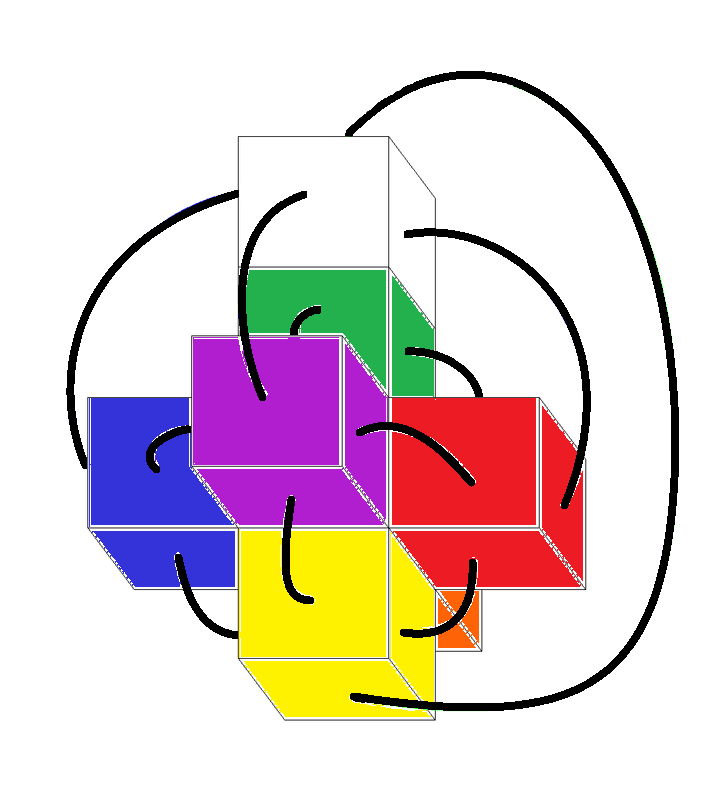
I thought it might be fun to make a dungeon built inside a tesseract, but mapping the thing is a bit of a challenge.  I eventually made this model that helps me to visualize travelling within the tesseract, so I thought I'd go ahead and share it.  I'm sure that I don't yet fully understand tesseracts but I'll go ahead and attempt to explain them anyhow.  Wish me luck.

A tesseract is the analog of a cube brought into four-dimensional Euclidean space; a tesseract is to a cube as a cube is to a square.

It might help to think of a tesseract as 8 different 3-D cubes that are attached in an extra-dimensional way.  Each cube shares a side with 6 of the other cubes (4 walls, floor, and ceiling).  However each cube also has an opposite cube on the other end of the tesseract that it can't touch directly, but both of these will touch all six of the others.

If someone were to be teleported into a tesseract the space within might seem to be perfectly ordinary at first.  There don't need to be any obvious distortions or bending of space, the person likely wouldn't notice anything amiss until they started travelling through multiple cubes.  Passing from one cube to another might be obvious, but it could also be something as innocuous as a doorway.  If the person inside picks any direction and walks in a straight line then they would end up passing through three new cubes, but the fourth cube they enter would be the original cube that they started from.  They are effectively trapped until they find some extra-dimensional means of escape.

My handy diagram is below.  The thick black lines show how the sides of the zones actually touch each other.  I've colored each of the cubes/zones to make reference easier.  It might help to think of the Green Zone as the starting point because the six directions (up, down, north, south, east, west) are all from the perspective of a stick figure person who is standing in that green cube facing the same direction as the viewer of the diagram (north).  Below the diagram is a list to help me navigate travel from one zone to another.  For example, "Green Up - White Down" means that taking stairs up through the ceiling of the green zone will bring you up through the floor of the white zone.


1. White Zone - Up
White Up - Yellow Up
White North - Orange Up
White South - Purple Up
White East - Red Up
White West - Blue Up
White Down - Green Up
8. Black Zone - Down (hidden center)
Black Up - Green Down
Black North - Orange Down
Black South - Purple Down
Black East - Red Down
Black West - Blue Down
Black Down - Yellow Down
2. Green Zone - Home Perspective
Green Up - White Down
Green North - Orange South
Green South - Purple North
Green East - Red West
Green West - Blue East
Green Down - Black Up
7. Yellow Zone - Opposite
Yellow Up - White Up
Yellow North - Purple South
Yellow South - Orange North
Yellow East - Blue West
Yellow West - Red East
Yellow Down - Black Down
3. Blue Zone - West
Blue Up - White West
Blue North - Orange West
Blue South - Purple West
Blue East - Green West
Blue West - Yellow East
Blue Down - Black West
6. Red Zone - East
Red Up - White East
Red North - Orange East
Red South - Purple East
Red East - Yellow West
Red West - Green East
Red Down - Black East
4. Purple Zone - South
Purple Up - White South
Purple North - Green South
Purple South - Yellow North
Purple East - Red South
Purple West - Blue South
Purple Down - Black South
5. Orange Zone - North
Orange Up - White North
Orange North - Yellow South
Orange South - Green North
Orange East - Red North
Orange West - Blue North
Orange Down - Black North


The Black Zone is hidden from view, it's in the center of the diagram surrounded by zones on all sides.  From the perspective of the other zones, the Black Zone is always down.  It might help to think of the Black Zone as being like the core of a planet, it's always down from the perspective of the surface.  That said, my understanding of how gravity functions in the tesseract is not great.  Does the Black Zone still have a floor that things fall toward?  Does everything fall toward the center of the Black Zone?  I'm not sure, to be honest.

I think of the White Zone as being "above" the other zones, while the Black Zone as "below".  This way the six middle zones will all seem to have the same gravity.  The white and black zones are going to have some kind of gravitational weirdness though.  I'm thinking of making them both zero gravity zones and maybe filling the black zone with water, but I'm still not sure.

I've labeled the Yellow Zone as "Opposite", but really that is just from the perspective of someone standing in the Green Zone.  Someone walking into the Yellow Zone wouldn't experience reverse gravity or anything, and their compass needles wouldn't suddenly move; I only meant that it's orientation is the reverse of the Green Zone.

I hope this helps someone.  It could make for a neat little eight room dungeon (Hut of Baba Yaga?), but I think I'm going to try for something larger where each zone is a different dungeon level with it's own particular theme.

February 24, 2016

Making custom classes using my rather confusing percentage based system, example #1; Custom Class: Goblin

If you don't want to read a bunch of thoughts on making custom classes, then just skip to the end.  There is a Goblin PC class there with a list of abilities and an xp chart.
---------------------------------

I've been thinking lately about customized classes.  I made this whole system a while back hoping to help DMs who like to create custom classes but worry about weighting the new xp charts so that they all stay relatively balanced with the original seven classes.  When adding a new class with more powerful abilities I always like to make sure that the class also has correspondingly higher xp requirements for leveling up.  Some DMs are probably comfortable looking at a list of class abilities and simply throwing out some numbers on an xp chart.  I can't really do that.  I need a method.  My method still has a bit of guesswork involved (especially regarding unique powers and abilities), but I feel like the framework helps to keep me honest and impartial.

Testing out xp charts takes a long time.  Over the course of many game sessions you watch the new classes level up beside the regular old fighters and thieves.  While I made this system quite a while back, I've only recently decided to be quite proud of it.  The classes (and xp charts) that I have made seem to be leveling up characters at appropriate rates.  I'm sure that more testing is needed (especially for higher level play), but for the levels below 10 it seems to work quite well.

My old posts about this custom class system are a bit of a mess.  I just sort of threw the whole thing out there without a very good explanation of how to use it.  I'm sure some people found it to be too frustrating and confusing to make proper use of (Sorry!), so I thought it was high time that I try to put together some kind of walkthrough to help people who are trying to understand it all.  I've made some classes and posted them on the blog here, but I probably could have done a better job of explaining how I get from the class concept beginning to the end where I have a whole list of abilities and an xp chart.

I plan to write out two more guides after this one (but don't hold your breath) in which I'll give a kind of rambling stream of consciousness account showing how I make a custom class from start to finish.  I hope someone out there finds this helpful, but sadly your guide in this endeavor is just as scatterbrained and descriptively challenged as ever.  Best of luck, gentle reader. 
---------------------------------

For this first example I thought I'd start with a custom class for a Goblin.  When you combine muderhobo tactics and easy access to the Charm Person spell, I find that a party of PCs will eventually pick up a goblin henchman/mascot somewhere along the way.  After a few adventures together the players might want their goblin buddy to level up alongside the PCs, so I might as well help to facilitate this by building a custom class for goblins.

So, first thing I'm going to do is pull up my old blogpost "Custom Classes for B/X" in a new tab and kinda flip back and forth as I'm typing this out and building the class.  I'm going to go through each of those tables one by one, and then at the end I'll do some math to make the Goblin class xp chart.


Step 1 - Base XP
There are three different Base XP Charts listed at the top there, and I need to decide which one of them to use for the Goblin class.  I don't feel like goblins are going to be using spellbooks, so the one on the right is out.  I don't really see goblins tithing 10% of their gold to anyone, so not the one on the left either.  That leaves me the middle column marked "Standard".  Let's go with that.  It looks like this...

Standard
0 --------- Level 1
400 ------- Level 2
800 ------- Level 3
1600 ------ Level 4
3200 ------ Level 5
6400 ------ Level 6
12800 ----- Level 7
24000 ----- Level 8
48000 ----- Level 9
 ~~~~~~~~~~~~~~~~
Level 10+
Add a flat amount to the total based upon hp gained

Standard
+100,000 --- +1 hp/level
+120,000 --- +2 hp/level
+130,000 --- +3 hp/level

OK!  I have the Base XP Chart picked out.  I'll set this aside for now.  In fact, this might work better as the last step.  I wanted to start here so that people would have a sense of what this whole process is working toward, but maybe it would serve better if it were at the end.  My blog (and brain) needs a better editor.


Step 1.5 - Write down "100%"
Every class starts with 100%.  As I go through each step I'll determine things like Hit Dice, Saving Throws, and special abilities; each of these will have a percentage point cost that adds onto this 100% base.  At the very end I'll tally up all these percentages and apply that total to the Base XP Chart from Step 1.  This will then give us the Goblin Class XP Chart.  Can't forget to start with this base 100% though.

I write down "Base: 100%".


Step 2 - Hit Dice
Hmm, how many hit points does a goblin gain each level?  Let me grab a drink while I take a moment to think about it.

I'm of the opinion that if you are going to give class levels to monsters then the entries in the monster manuals don't necessarily apply to level 1 monsters only, but show more of an average; like say up to level 2 or 3 at the top end.  I'm gonna to be a dick and give goblins fewer hit points than thieves and magic-users.  I don't want any PC thieves feeling silent resentment that their class is getting overshadowed by the mechanics of some crappy goblin class (I would absolutely delight in having their individual PC outshined by some crappy goblin NPC, but that is a whole different issue).  Looking at the class abilities side by side, I want it to be pretty obvious that goblins have the deck stacked against them.  This class needs to suck.  I'm gonna say that goblins get d3 hit points each level.  Glancing over at my Custom Class Tables I decide that the cost for d3 is +15%.

I write down "d3hp: +15%" underneath the 100% I wrote earlier.


Step 3 - Hit Progression
Goblin combat skills aren't up to fighter caliber for sure, but I still think they should fight better than a magic-user.  I'll have them use the Cleric/Thief Hit Progression table.  Incidentally, this also shows that goblins would get +1hp at level 10 and beyond, but I'm certain that I'm going to set their level limit low enough that it never comes into play.

I write down "Cleric/Thief Hit Progression: +30%". 


Step 4 - Level Limit 
Oh already?  I was just thinking about this.  Um, I'm gonna say that goblins max out at level 7.  I want the Halfling player look down their nose at the goblin and think to themselves "Well, at least I can get to level 8". 
 
I write down "Level Limit 7: +0%
".  


Step 5 - Saving Throws
A lot of times I'll give classes with a low level limit access to the Dwarf/Halfling saving throws.  Not this time.  I think that goblins were meant to suffer.  I'm going to give them Thief saving throws, even knowing that they max out at level 7.  

I write down "Thief saves: +10%".


Step 6 - Armor
I'm a bit torn here.  I can picture goblins wearing hide armor and even repurposed dwarven scale mail, but I also know that I'm going to be giving goblins some thief type skills later, so maybe I should restrict them to only thief type armors?  Hmm, compromise.  I'll just mention in the class description that they can make use of many materials as armor, but that goblin piecemeal armor only ever gives the same protection as studded leather. 

 I write down "Padded, Leather, and Goblin Piecemeal: +10%".  Then I remember to include shield use and hurriedly write down "Oh and shields too: add another +10%"


Step 7 - Weapons
I always imagined that goblins were fairly small, so I'm thinking that they should have the same weapon restrictions as dwarves and halflings.  Being able to use any weapon costs +90%, so I'll just start with that and subtract off the weapons they can't use: Long Bows -5%, Quarterstaff -5%, Heavy Weapons -10%, and Pole Arms -15%.  

I write down "No Long Bows, Quarterstaff, Heavy Weapons, or Pole Arms: +55%".


Step 8 - Magic Items
I don't really see goblins using cleric or magic-user scrolls.  Goblins probably aren't much for literacy in general.  I don't really think that wands are their thing either.  It might be fun to let goblins use those items incorrectly, but there is no real reason to make them pay any xp cost for that.

I write down "Can incorrectly use cleric scrolls, magic-user scrolls, and wands.  Other magic items are fine: +30%". 


Step 9 - Extras
I'm of the opinion that goblins should have some thief skills, but not all of them.  Also, goblin will max out at level 7, so the PC thief is going be better at all this stuff eventually.  I think that Open Locks requires more intelligence and patience than a goblin has, goblins probably just bash locks open.  Backstab is another that I feel should be PC thief only, so that one is out too.  I think all the others are fair game though.  They should speak Common and Goblin, but that costs 0%, so I don't even write it down.

I write down "Remove Traps, Pick Pockets, Move Silently, Climb Sheer Surface, Hide in Shadows, Hear Noise: +60%".  Actually I wrote down each of those individually with a +10% after each one.  


Step 10 - Beyond Human Abilities
Infravision!  It's super handy.  And... um... I'm struggling to think of any other goblin ability.  Oh!  The monster listing in Labyrinth Lord says that they get -1 to-hit in full sunlight.  Also it says that their Infravision is 90' range... does that cost more than 60' infravision then?  Also they ride worgs, but it's not like humans pay extra xp to ride horses, so I'm just gonna call that +0%.  I'm thinking that the attack penalty in sunlight should cancel out the extra range bonus too, so I'll just have goblin infravision cost the same as the elf and dwarf versions.

I write down "Infravision 90' range, and -1 to hit in full sunlight: +15%"


Step 11 - Spell Progression
None. Zero. Just nothing.  I still reserve the right to use an NPC goblin shaman, but that's a class write up for another day.

I write down "Spellcasting: squat"


Step 12 - Make the damned XP Chart
Looking over the notes I've written...


Goblin Class
Base: 100%
d3hp: +15%
Cleric/Thief Hit Progression: +30%
Level Limit 7: +0%
Thief saves: +10%
Padded, Leather, and Goblin Piecemeal: +10%
Oh and shields too: add another +10%
No Long Bows, Quarterstaff, Heavy Weapons, or Pole Arms: +55%
Can incorrectly use cleric scrolls, magic-user scrolls, and wands.  Other magic items are fine: +30%
Remove Traps +10%
Pick Pockets +10%
Move Silently +10%
Climb Sheer Surface +10%
Hide in Shadows +10%
Hear Noise +10%
Infravision 90' range, and -1 to hit in full sunlight: +15%
Spellcasting: squat

So I total that up...

I write "TOTAL: 335%"

then a double check my math...
Then I triple check my math since I started drinking back at like Step 2...

the math still looks good!

Now I pull out that Standard Base XP Chart from back at Step 1, and multiply each of those X 3.35
I don't bother with the levels after 7 since that is now the goblin max level.  I end up with something like this...

3.35 X 0 = Level 1 ----- 0xp
3.35 X 400 = Level 2 ----- 1340xp
3.35 X 800 = Level 3 ----- 2680xp
3.35 X 1600 = Level 4 ----- 5360xp
3.35 X 3200 = Level 5 ----- 10,720xp
3.35 X 6400 = Level 6 ----- 21,440xp
3.35 X 12800 = Level 7 ----- 42,880xp

So, now is when I would usually polish it all up and look everything over once I was sober before I posted any of this to my blog, but this is for a crapsack goblin class so whatever.  Who cares, it's done.

I hope that this was enlightening, or at least interesting.  Not tedious?  oh well...

I certainly enjoyed it.  Making custom classes is a passion, if you enjoy it too then please say so in the comments.  I plan to do two more of these step by step guides.  Feel free to suggest new classes if you want to watch me stat them up with xp charts.

February 5, 2016

Deep Carbon Deaths

Wow, I need to post more often.

We finished our Deep Carbon campaign, and it was awesome.  We left it on a cliffhanger though because life happened and two of the four players had to drop out.  We're starting a new campaign now, but before I start posting about all that I thought I should share some highlights from our Deep Carbon games.
--------------------------------

Session #1 (not counting that session where all we did was make some 2nd edition PCs with 8,000xp and some henchmen with 1,500xp, and also we rolled up some random magic items for the main characters to start off with)

I changed up the setting a bit. http://quibish.blogspot.com/2015/08/a-deep-carbon-observatory-campaign.html

The party is headed to Carrowmore following multiple rumors about some hidden treasure palace under a lake somewhere north of there. They decide to avoid the road due to reports of bandit/cannibal reaver attacks. They instead trust the PC Fighter/Mage who says he knows of a safe path through the mountains.

They become terribly lost.

First encounter of the campaign: Ettin

The Fighter/Mage redeems himself by killing the Ettin with his randomly rolled SWORD OF FREAKING GIANT SLAYING, but not before the ettin kills one of the fighter henchmen.

Killing off a henchman in the first encounter of the campaign really helps set the tone I think.

After that they head into Carrowmore and we go through that event flow chart thing that works like a dream to convey the sense of total chaos and destruction caused by the flood. Seriously, that one page had a ton of fun and gameable material. It's like an entire adventure module condensed down to a single page.

My favorite part was when the Dwarf Sharpshooter grabbed the boy who was trying to steal scrolls and demanded to know why. The boy said "They made me do it." and when he started to point up at a building an arrow shot into his neck and the boy died in the dwarf's arms. 8-0 <---- The guy who plays the dwarf. The Crows are awesome.

I decided early on that the PC Dwarf Sharpshooter had heard a bit about Ghar Zaghouan and Zolushika Von Der Linth, because that background info is too good not to share. He didn't put it together until session #3 though when some zombies attacked and from out of nowhere he suddenly got shot with an Eel Cyst and had did dig that thing out with a knife because he knew EXACTLY what would happen if he failed. Also the cleric got hit with an Eye Bolt which I gave no clues about at all, but the guy who plays the cleric is a smart man and figured it out all on his own, so he started wearing a piece of cloth to cover that eye. That is all that the players know about The Crows so far.

Total Dead: 1
----------------------------------------------------------


Session #3

The party has a close call with the cow-sized killer platypus. The great beast wins surprise. I decide to read the description verbatim from the booklet in a slow deep voice.

"It has returned: the most dangerous duck-billed platypus to ever walk the earth. The battle begins once more."

It shoots up out of the water without warning and grabs onto the side of the boat with it claws. The boat starts rocking, pitching over to the side. Everyone grabs hold of the boat to keep from falling into the water, some pull out a weapon with one hand. The platypus scores a critical hit ruining one of the dwarf henchman's eyes as it gobbles him up into it's bill preparing to grind him into goo. A critical hit from a party member strikes the platypus in the head and stuns it just in time. The party is able to pull the dwarf henchman from it's horrible duck-billed maw just as it sinks below the surface. They paddle the hell out of there as fast as they can.

Not an actual death, but that's how the dwarf henchman lost an eye.
-------------------------------------------------------------


Session #5

They all survive the flooded lands, the dam, and the golems. They make it to the dungeon entrance and descend down into the deep. In the first room of the dungeon proper they investigate the terraces and statues. The priest of the sun god recites an ancient prayer to Utu (A Greeting to the Dawn) in the traditional ancient Sumerian. Unknown to the players, I decide that there is a small chance that some of the trigger words for this room would have been passed down into the prayers of the sun god (as Utu was the head of security for this complex back in the day).

"Roll a d20 and get a 20" I said. *20!* The first row of statues kneel and bow their heads to the ground revealing the stairs carved into their backs. The priest starts rattling off every prayer he knows to the statues. He speaks slow and deliberately so that they can try to determine what the actual command words are. I decide that there are 3 other relevant prayers, each of these prayers has a 1 in 20 chance of having had the command word preserved unchanged as they were passed down through all those long centuries.

"Roll a d20 and get a 1" I said. 1! The forth row of statues kneel.

"Roll a d20 and get a 20" I said. 20! The second row of statues kneel.

"Roll a d20 and get a 1" I said. 12 :(

The priest and the wizard start calling out every word of ancient Sumerian that they can think of hoping to hit upon that last command word. They never find the word, but all this talking draws the attention of the giant.

He does not surprise them, but is far too close for comfort when they turn to see him squeezing into the room like Eugene Tooms.

They do battle and score a lot of damage (thanks to the d30 house rule), but the giant... He Just Keeps Coming. The priest dies first, horribly twisted in half and gobbled down. The party bolts. They run up the stairs toward the surface, but the giant gets a swipe at the Dwarf Sharpshooter who is the last to go up. Critical hit on the Arduin chart says that the giant grabs the dwarf's nose between his giant knuckles and rips it off his face, reducing the poor guy's Charisma to 4 and screwing up the way he talks for the next 7 months. http://jrients.blogspot.com/2007/08/great-random-charts-from-rpg-history.html

The party runs up the stairs. The extremely long, extremely steep stairs. They make Constitution checks as they run. The giant follows more slowly, but with his giant-sized Con. The party stops to rest once and takes off again as the giant gets close. When another Con check fails some of the party decide to stop and make a last stand on a landing, but most of the others run for their lives when the giant appears.

The fighter/magic-user with the sword of giant slaying and his fighter henchman put up an awesome fight. One of them scores a critical to the giant's neck, but eventually they both are killed. The giant is so wounded after this that he goes back downstairs and eventually dies from blood loss due to the neck wound.

Total Dead: 4
Remaining Survivors: 6
Total Rooms Explored: 1
---------------------------------------------


Session #7

That dwarf henchman who lost an eye to the platypus dies when he is absorbed into the horrible undead red ooze, an animated thickened reduction made in ages past by simmering down the blood of countless slaves. During the game session I might have actually blurted out "Black Pudding" or something, but whatever... I knew what I meant. After the dwarf henchy died the mage proceeded to burn the crap out of the slime monster with a Flaming Sphere spell.

Not a monster from the module as written, but one of the players was sleep deprived or something so when I saw him starting to nod off at the table I decided it was monster time.

Total Dead: 5
Remaining Survivors: 5
Total Rooms Explored: 12
---------------------------------------------


Session#9

No one expects the Neptunium Child.

In the end the Halfling Thief picks up all three of the items. 15 points of radiation damage, and -1 max hp per day. Next he is compelled to cut out his own tongue, and easily evades the party members who try to stop him. After all this he decides to plunge the green-flamed blade into his own heart, thus carrying the dangerous artifacts with his corpse into the shallow pool of clear viscous fluid.

Brutal.

In hindsight, I should have just kept the -1 max hp per day thing to myself until it became relevant. c'est la vie... ?

Total Deaths: 6
Remaining Survivors: 4
Total Rooms Explored: 20

P.S. and they totally refused to open the big box in room #22, probably because the halfling's death was a bit too fresh in everyone's mind. I am disappoint. Next session is on the 17th, maybe they'll go back and surprise me.
---------------------------------------------


Session#10

They go back through the first room and encounter a lone zombie standing at the bottom of the stairs. It's holding a long piece of fabric (2'x1') with both hands. It approaches them and holds up the fabric stretching it taut between it's arms. The sign reads "Truce?". The zombie hands over the fabric that was once a pant leg and heads back up the stairs. On the other side of the sign is "If yes give a coin to the next zombie", this is all written in blood of course.

The party camps here in the room with the giant's corpse waiting for the next zombie. The zombie arrives the next day and takes a coin from them. They wait and wait and eventually take turns sleeping and then wait some more.

Frustrated, the party decides to continue exploring. They find and rescue an ancient man locked in metal stocks. He knew the final password and they speak Sumerian, so it all worked out; they got the key and freed him. He babbles on and is far from sane, but he begins to show them the wonders of the Deep Carbon Observatory.

They see the ooze bots, but leave them untouched.

They meet the Toxmen who promise to stay in their air-tight chamber for a day or two if the party would be so kind as to just unlock the door, which they do.

The party meets the salt dryads who try to engage them with stimulating conversation, but overwhelmed and perplexed the party moves on.

The party finds a temple wall covered in dinosaur hieroglyphics and the mage feels compelled to study and interpret them. This takes quite a long time, but the mage begins to decipher bits and pieces; a prophecy about a coming war between dinosaurs and man.

About this time a giant arm covered with many wounds reaches into the room, and the party looks up to see a giant face splattered with dried blood slowly squeezing it's way into the chamber as giant dead milky eyes roll about until it focuses it's gaze upon them. This is Zalushika's finest hour.

End Session
End Campaign
----------------------------------


I plan to go easier on the poor PCs next time, but I have to admit that it was fun to have a short brutal campaign where I could bring down the fury.

August 16, 2015

Deep Carbon campaign - Session 1: the Prepening

Session 1: We made characters.

That was our whole first session.  I felt bad about it.  My brain was all sleep deprived and slow that day, so I wasn't much help speeding things along.

I'd forgotten how long character creation takes in 2nd edition.  I probably should have made some pregenerated henchmen beforehand.  Having everyone make multiple characters just took way too long.  All the players flipped through the splat books and picked out kits for their PCs, and that slowed things down for sure.  Proficiencies took a while to sort out too.  The henchmen didn't get kits or proficiencies and had to make due with secondary skills instead.  It all took up way too much time, and we didn't even run an encounter that night.  Oh, and I decided to try out some Last Gasp Grimoire style encumbrance, so making all those item squares took extra time as well.

I made some 2nd edition character sheets for use with the new encumbrance system.  These are mostly just copy/paste mashups of other peoples work.  Honestly, I don't even recall where that character sheet came from originally.  I did some redesign work to make it 2nd edition compliant and must have copied over the original.


This all works mostly as described at Last Gasp.  You're unencumbered if you don't have any dead weight stuffed into backpacks and satchels.  If you are carrying laden packs and you're packed items are less than your Strength score you are lightly encumbered.  If you packed more items than your Strength and Constitution combined then you are severely encumbered.  It's fairly lenient I think considering those 15 unencumbered slots.

I'm more interested in the bit about attacks hitting items and item breakage.  Instead of opposed attack rolls as detailed at Last Gasp, I'm doing the standard d20 vs. AC thing so I ended up renumbering those item slots a bit.  If a character is hit, they roll a d6 on the Armor row to see which item was hit.  This armor row is reserved just for suits of armor, shield, and bits and bobs like helmet and gauntlets.  You'll still take full damage, but we'll also check to see if that item is damaged as well.  If the result is an empty slot then only the PC is being damaged.  If a 6 was rolled then you roll another d6 on the Loose Items row.  If that is also a 6 then you roll a d6 again on the Held & Protected row.  If you end up rolling three 6's in a row then you've tumbled out of the way in the knick of time and that hit becomes a miss instead.

I'm excited to try this out.

In addition to all the packs and item squares I downloaded from Last Gasp, I also made up this sheet of item squares to represent the backpacks themselves.  These will get stuck onto the character sheet above so that the character's backpacks have a chance of getting damaged as well.


I also found some sheets for Magic-User's Spellbooks and Cleric's Breviary that I quite liked.  Big thanks to Christopher at The Aspiring Lich for those.  They were made for Labyrinth Lord, so I changed the numbers a bit for use with AD&D 2nd edition rules.